


 2 / 318

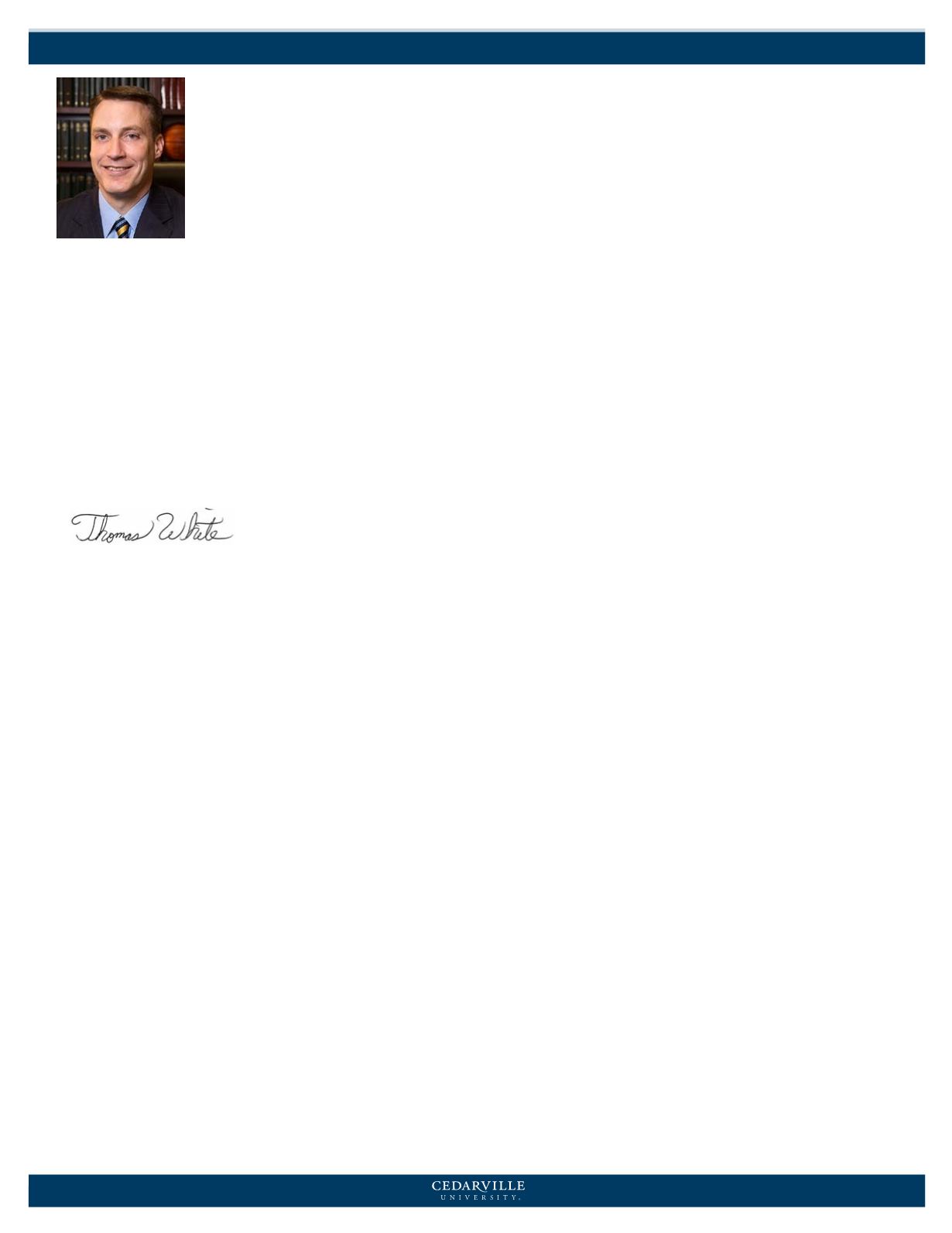
AWord From Our President
You will spend approximately 1,000
days on campus at Cedarville University.
It is our desire that every classroom
session, every chapel service, every
meeting, every sporting event, every
extracurricular activity will set you on
a trajectory to glorify God with the
remainder of your life.
As you read this catalog, you will see
that Cedarville University glorifies God by
providing comprehensive education consistent with biblical truth.
A biblical worldview guides every course, every professor affirms
and teaches by our doctrinal statement, and your Bible minor
will equip you to understand and apply the Bible so that you can
defend your theological beliefs.
We desire to have academic excellence with a Gospel purpose.
We desire for every student to participate in an international
missions trip and to discover how God wants to use your gifts for
His glory. Every vocation is rooted in a biblical worldview and has
an eternal purpose.
God is moving at Cedarville, and we hope that you will join us
and have fun while praying for revival. We must engage culture
with compassionate conviction while standing for the Word of God
and the Testimony of Jesus Christ.
By faith,
Thomas White, Ph.D.
President, Cedarville University
History
Cedarville College was established in 1887 by five godly men
who envisioned a college that would provide Christian higher
education. Affiliated with the Reformed Presbyterian Church, the
College built its first building, Old Main (now called Founders Hall),
in 1895.
The turbulence of the first 50 years of the 20th century led
to hard times for the College. By the end of World War II, the
Board of Trustees realized that enrollment could not support
expenses, but, as God would ordain it, the Baptist Bible Institute of
Cleveland, Ohio, was seeking to expand. That institution’s Board
of Trustees became convinced Cedarville was the place God had
chosen.
By mutual agreement of both trustee boards, ownership of the
College transferred in 1953, and Cedarville became a Baptist
college of arts and sciences. Dr. James T. Jeremiah was called as
president.
By 1959, Cedarville’s enrollment had grown to 255. Six years
later, the student body nearly tripled to 763. By the end of
Jeremiah’s 25-year tenure as president in 1978, enrollment had
grown to more than 1,200 students. That same year, Dr. Paul
Dixon was called to lead Cedarville.
In 2002, the Board of Trustees unanimously voted to change
from Cedarville College to Cedarville University. This move
better communicated Cedarville’s expanded academic offerings,
graduate studies, institutional organization, and increased national
and international presence.
By the end of Dixon’s 25-year tenure as president in 2003, the
student body had grown to more than 3,000 students. Under his
leadership, Cedarville added nursing and engineering majors and
constructed the Dixon Ministry Center and the Stevens Student
Center.
In 2003, Dr. Bill Brown became the next president of Cedarville
University. Under Brown’s leadership, Cedarville built the Center
for Biblical and Theological Studies and Health Sciences Center
and launched four new graduate programs.
In 2013, Dr. Thomas White became the 10th president of
Cedarville University. Under his leadership, the University
embarked on an extensive renovation of the Jeremiah Chapel,
built new science laboratories, established two additional graduate
programs, and founded the Center for Biblical Apologetics and
Public Christianity.
Profile
Home to 3,700 Christian students, Cedarville University is an
accredited, Christ-centered, Baptist university of arts, sciences,
professional, and graduate programs located in southwest
Ohio. Since its founding in 1887, Cedarville has maintained its
commitment to biblical truth and academic excellence to equip
students for academic success, professional leadership, and
spiritual influence. This intentional focus has earned Cedarville a
national reputation as a leader in liberal arts, health sciences, and
professional programs.
Cedarville’s undergraduate curriculum is built upon a liberal arts
core including biblical education, communications, global studies,
humanities, physical education, science and mathematics, and
the social sciences. From this foundation, the University’s 76
undergraduate degree programs provide concentrated study
leading to one of eight baccalaureate degrees.
Graduate programs are a growing segment of Cedarville’s
educational array. Now offering five master’s and doctoral degrees
and two certificate programs in the areas of business, nursing,
education, ministry, and pharmacy, these programs — four
available fully online — build on the University’s undergraduate
reputation, but serve the unique needs of adult students.
Mission and Vision
Cedarville University is a Christ-centered learning community
equipping students for lifelong leadership and service through an
education marked by excellence and grounded in biblical truth.
The University accomplishes the following objectives or “portrait
statements” which reflect characteristics of a Cedarville University
graduate:
Glorify God
The Cedarville graduate exemplifies devotion to the triune
God, Christlike character, and faithfulness to the teachings of the
Scriptures.
Think Broadly and Deeply
The Cedarville graduate evaluates ideas, practices, and theories
across disciplines within the framework of God’s revelation.
Communicate Effectively
The Cedarville graduate listens well, and produces and delivers
clear, compelling, accurate, and truthful messages in a relevant,
respectful manner.
Develop Academically and Professionally
The Cedarville graduate demonstrates competence and
integrity in academic and professional endeavors.
Engage for Christ
The Cedarville graduate lives to further the mission of Christ in
the world as an active influence in spiritual, moral, professional,
and social spheres.
Page
2
2017–18 Undergraduate Academic Catalog
Introduction
A Word From Our President