



 137 / 318

L. Delyte Morris
, Professor of Allied Health; Licensed Physician
Assistant; Coach, women’s tennis.
Education:
B.S., Geneva
College, 1959; M.S., Indiana University, 1960; P.E.D., Indiana
University, 1966; A.S., Kettering College of Medical Arts, 1979. At
Cedarville since 1998.
Elizabeth Sled
, Assistant Professor of Kinesiology.
Education:
B.S.c.P.T., Queens University, 1990; M.S.C., Ohio State University,
1996; Ph.D., Queens University, 2008. At Cedarville since 2012.
Michael Weller
, Associate Professor of Athletic Training; Certified
Athletic Trainer (BOC); ATEP Program Director.
Education:
B.A.,
Capital University, 1995; M.S., Ohio University, 1997. At Cedarville
since 2010.
Emeriti
Donald Callan
, Professor Emeritus of Exercise and Sport
Science; Founder, Missions Involvement Services (MIS); NAIA
Hall of Fame, 1990.
Education:
B.S., Taylor University, 1955;
M.A., Ball State Teachers College, 1960; Ph.D., The Ohio State
University, 1968. At Cedarville since 1960.
Kathleen Freese
, Associate Professor Emerita of Kinesiology.
Education:
B.S., Bowling Green State University, 1971; M.Ed.,
Bowling Green State University, 1981. At Cedarville since 1991.
John McGillivray
, Associate Professor Emeritus of Kinesiology;
NAIA Hall of Fame, 1993.
Education:
B.S., Cedarville University,
1970; graduate study, Wright State University, 1972–74; M.S.,
University of Dayton, 1976. At Cedarville since 1974.
Staff Clinical Instructor
Amanda Meade,
AT.
Education:
B.S., Wilmington College, 2010;
M.S., University of Kentucky, 2012. At Cedarville since 2012.
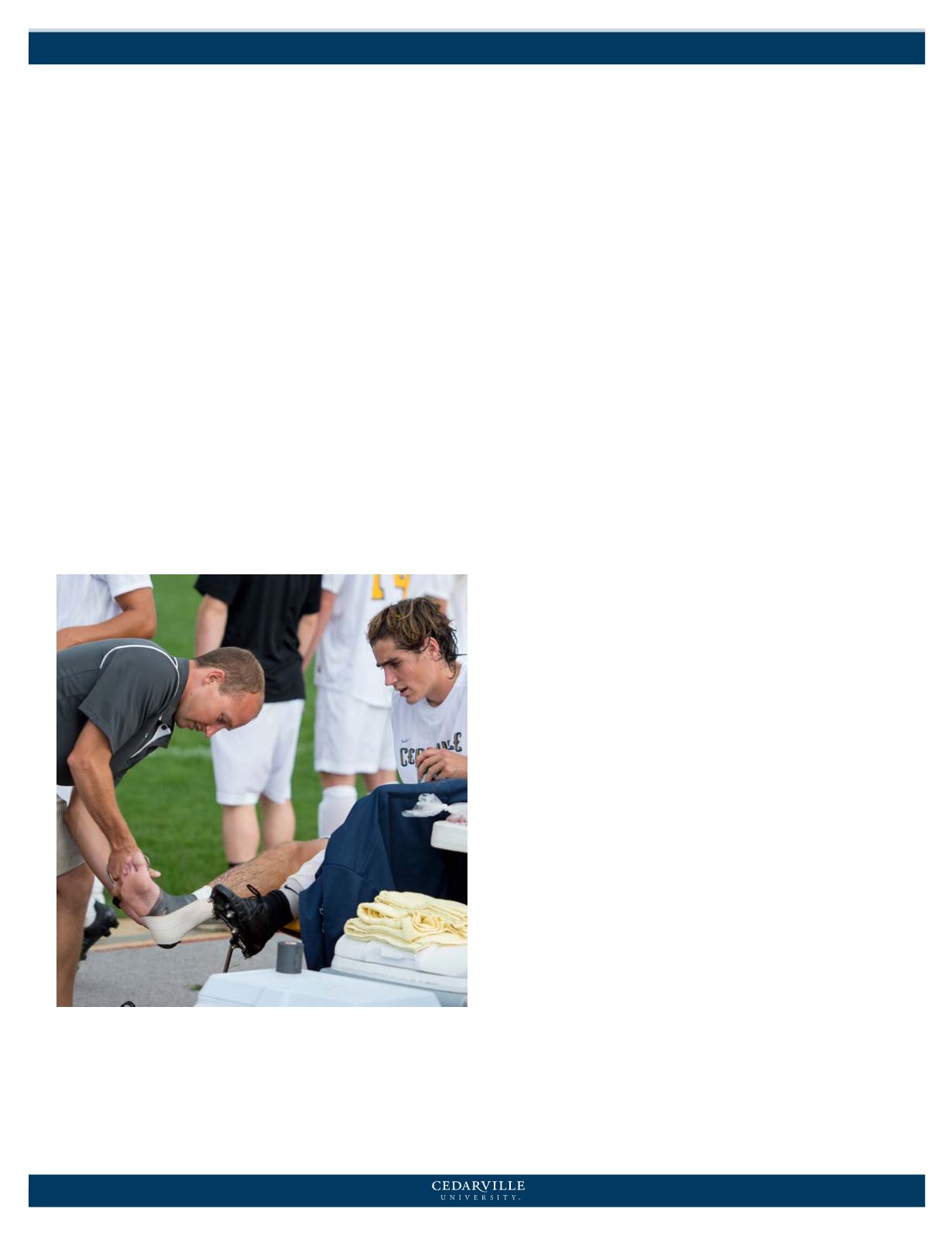
Athletic Training Mission Statement
The mission of the Cedarville University Athletic Training
Education Program (ATEP) is to advance the Kingdom of
Christ by preparing entry-level athletic trainers, through diverse
learning experiences, to practice competently and professionally
throughout the world.
This is to be accomplished through an educational program that
practices the skills associated with the prevention, diagnosis, and
intervention of emergency, acute, and chronic medical conditions
involving impairment, functional limitations, and disabilities.
Students will be able to:
• Provide quality healthcare including prevention, diagnosis,
and intervention to patients and clients who participate in
physical activity.
• Utilize therapeutic techniques and equipment safely,
appropriately, and effectively.
• Instruct patients and clients in areas of prevention,
stewardship, and convalescence.
• Implement organizational skills to manage an athletic training
facility.
• Locate, interpret, and implement athletic training research.
• Conduct themselves professionally with Christlike
characteristics.
The athletic training major prepares students for a career as a
Certified Athletic Trainer (or ATC), which is the official credential
awarded when students successfully pass the certification exam
administered by the BOC. Cedarville’s athletic training program
meets the requirements set forth by the National Athletic Trainers’
Association (NATA) and the Commission on Accreditation of
Athletic Training Education (CAATE).
Personal Requirements
Athletic training requires a significant level of scientific and
clinical preparation. Prospective athletic training students are
encouraged to take college preparatory courses in high school,
including biology, chemistry, physics, and advanced math. An ACT
composite score of 24 (or SAT composite of 1100) or higher is
highly recommended.
Typically, the student who is interested in athletic training as
a potential career has a history of being involved in athletics
personally and may even wish to pursue participating in athletics
at the collegiate level. Students need to be aware that the (ATEP)
depends on the varsity athletic program at Cedarville as well as
high schools, colleges, and clinics in the community to provide
the primary “laboratory” experiences for the clinical education
component of the program. Therefore, attempting to participate in
varsity athletics while simultaneously pursuing the athletic training
major may prove to be a significant conflict of interest.
Students are, however, expected to model appropriate
stewardship of their physical bodies by being involved in a
consistent program of regular exercise and activity.
2017–18 Undergraduate Academic Catalog
Page
137
Department of Kinesiology and Allied Health
Athletic Training Mission Statement